Sunday, 21 September 2014

Do our municipal candidates support the Active Communities Pledge?


The Active Communities Pledge ( http://www.activecommunitiespledge.ca/ ) a is a province-wide initiative being organized by the Share the Road Cycling Coalition, asking municipal candidates to support measures that would improve access to active transportation infrastructure, provide more opportunities for residents to learn how to ride a bike safely and legally and support programs designed to encourage more residents to walk or bike more often.

All across Ontario, communities are seeing the benefits of investing in active transportation. Communities that are more walkable and bikeable have higher retail spends, higher land values, stronger talent retention and healthier, more active residents. Additionally, communities that are investing in active transportation are becoming tourism destinations, garnering a piece of Ontario’s $291 Million per year cycle tourism industry.

We also know that support for investments in active transportation infrastructure is very high. In a 2014 survey, 68% of Ontario residents agreed that government should invest more in creating active transportation infrastructure. 66% agreed that getting more people on bikes helps everyone in the province, not just those who ride themselves.

So GCAT has requested that municipal candidates submit their pledge at http://www.activecommunitiespledge.ca/pledge-candidate.php and commit to making Guelph a safer, more comfortable place to walk and bike, and to help create a healthier, more prosperous community for the next four years. 

We will publish the names of those candidates who have taken the Active Communities Pledge in another blog post in a few weeks. Stay tuned!

Sunday, 14 September 2014

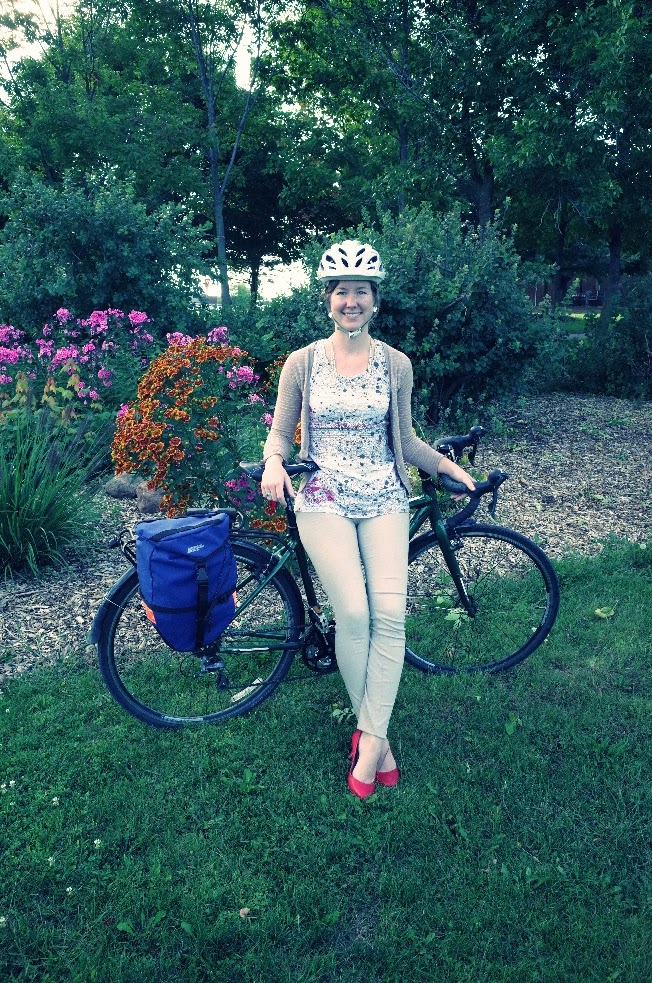
Jennifer Juste, Transportation Demand Coordinator (TDM), City of Guelph


R0001451.JPG
Tell us a little bit about yourself :
I first came to Guelph to do a Bachelor of Science at the University and fell in love with the city. In 2006, a year before graduating, I was hired by the City to start the TDM program.  The Cycling Master Plan started off as the “Bicycle Friendly Guelph” initiative.  We did a survey of best practices of cycling infrastructure around the world where there is a high number of people cycling in the community.  From these best practices we came up with the 5 E’s--education, enforcement, engineering, encouragement, evaluation.
In 2009, I returned to school to do a Masters in urban planning from McGill University. As well, I was fortunate enough to spend a year in Strasbourg France.  Strasbourg is France’s #1 cycling city, which gives me a great perspective in what great cycling infrastructure could look like. When I returned to Guelph in 2012, I continued preparing the Cycling Master Plan. I was happy in February 2013, when the Guelph Cycling Master Plan was passed almost unanimously by City Council.
Why is riding a bike important to you?
To me, it’s a very enjoyable way of getting around the city. I can appreciate my community. I can see things in my neighbourhood, I get exercise and I feel great when I get to my destination. I am also concerned about climate change and want to do something personally to help reduce our greenhouse gas emissions.
How has it changed your life?
I’ve been cycling since my undergrad. I grew up in a suburban community in the GTA where I was totally dependent on my parents for getting around.  When I was a student, I noticed that it was so much more efficient to bike than to walk or take the bus.  Now, I won’t go back to living a life of car dependency.
I’ve made decisions about where I live by whether or not I can shop and get to work by bike from home.
Where do you go on the bike?
Everywhere!  I’m more of a utilitarian cyclist.  I don’t do big long rides in the countryside but I use my bike to do ordinary things like run errands, visit friends, go for a drink with friends.  I also try to go to meetings by bike: I found that breaking up my day by getting exercise allows me to be more focussed.  It’s a little pick me up in the day.
When do you use the car?
My parents live 2 hours away and there is no bus access so I have to drive.  In town, I use the car when I take big weekly grocery trips.
What is the hardest thing about using the bike for transportation?
Winter! Winter is pretty tough.  I don’t have the luxury of having multiple bikes and my bike is not made for winter situations.  I walk in winter.
Were there fears you had about city cycling in the beginning that have been disproved?
I had the opportunity to shadow the CELP (Community Environmental Leadership Program) when the participants learned city cycling skills.  It was transformative for me. There are a lot of rights I didn’t know I had and I learned to own my space on the road.
Do you find yourself trying to convert non-cyclists or recreationalists to give bikes a try?
Yes.  It is my job!
What kind of bikes do you ride?
My bike is a Trek Cross Rip.  It’s a hybrid cyclocross bike which is perfect for commuting occasional trails and long distance road trips. I have a rack so that I can add my panniers. The bike is lightweight and manoeuvrable.  I love it.  My back-up bike is a vintage 1972 racing bike, steel frame and I just keep it tuned up.
How would you respond to people who feel a car is just safer?
Well, if it comes down to a competition between a car and a bike, a car will win. But, it’s also a question of a tipping point: Once we see a critical mass of cyclists on the road, drivers will pay more attention.  Right now there is a lack of awareness and motorists don’t see the cyclists.  Also, cyclists need to follow the rules of the road so as not to do anything unpredictable to put themselves in danger.
  R0001445.JPG
What needs to happen in Canada to make the culture, and eventually the roads, more bike friendly?
I think we need to stop thinking of cyclists as vehicles. They are A stand-alone category. They don’t look like vehicles or act like vehicles and they aren’t insured. It isn’t fair to put them on the same playing field as a machine that weighs 2 tonnes and goes 80 km per hour. In future, I hope cities will see that the safest place for a bike is off the road.  As well, intersections are key.  Copenhagen gets that and they have created a cycling highway (link http://gas2.org/2014/08/11/copenhagen-cycle-snake-elevated-highway-bikes/).
I also think that we need to be less afraid of the exercise aspect.  People overestimate how difficult it is to bike.  Everyone should give it a try.
What is the best part of your commute?
I usually use my commute as an opportunity to meditate.  I reflect on the things I’m grateful for and to appreciate our community, the seasons, the weather...  I have even learned to love winter! When driving a car, you can’t liberate your mind to appreciate these things, because you have to be so concentrated on traffic and many other things.
What is the worst part of your commute?
Unforeseen downpours, when I don’t come to work prepared for them!
What infrastructure change would make your commute better?
There’s a place in the city where I have to either carry my bike down a flight of stairs or illegally cross at an intersection. Neither option is ideal.  Bike tracks on the stairs would help.  (I’ll try to make it happen!)
What bit of advice would you like to share with new bike commuters?
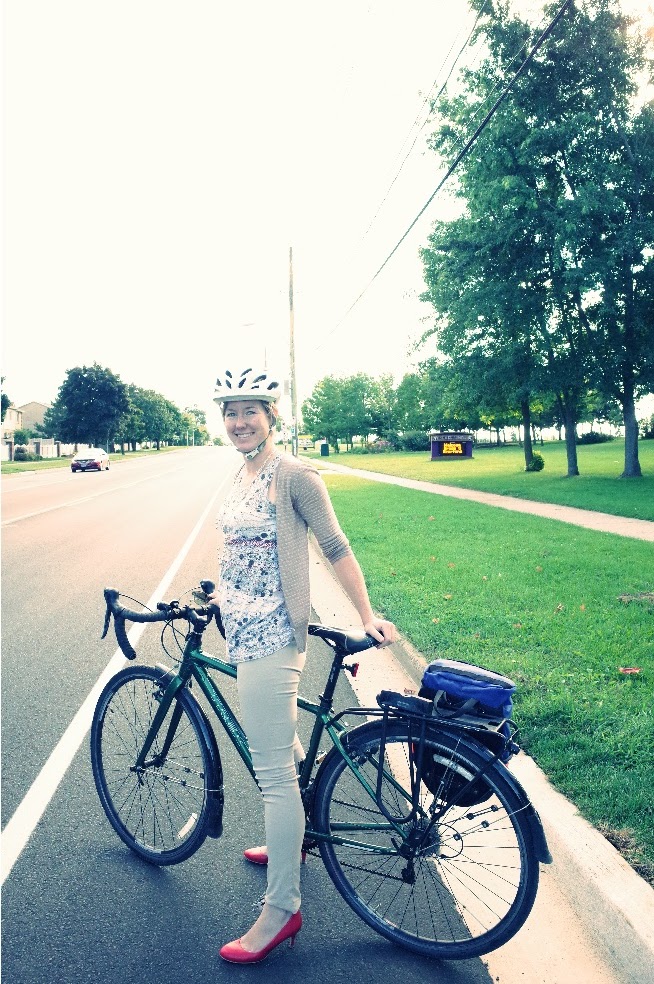
You don’t have to special gear. I often bike in heels and a dress. I usually plan my route to avoid hills.  Check out guelph.ca/bike (http://www.guelph.ca/bike) and inform yourself of the rules of the road, your route options, and other useful information.  Once you know your rights, you will be more comfortable and confident on the road.
It’s always a good idea to have an extra bus ticket with you because if you don’t feel like biking home, you can just put it on the front of the bus.

R0001449.JPG
Jennifer poses in front of  new bike lane on College Avenue

Monday, 1 September 2014

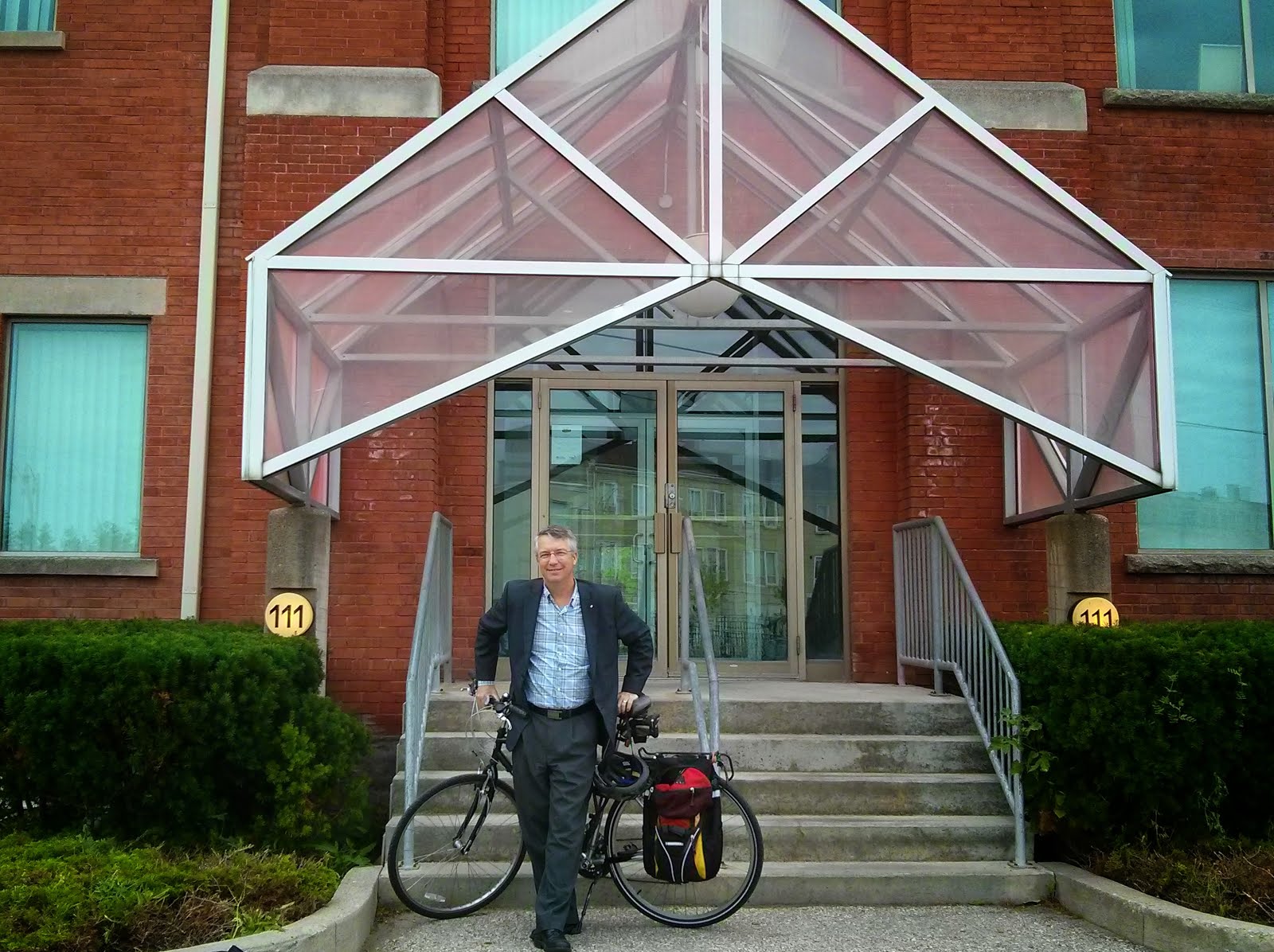
Profile of Lloyd Longfield, CEO, Chamber of Commerce, commuter cyclist


IMG_20140815_095325.jpg

Why is riding a bike important to you?
I just like riding a bike. Growing up, I was always on a bike.

I used to sit on the 401, going to work in Toronto, day after day, and I would dream of riding my bike to work.  Now I get to live that dream.

How does riding change your relationship with your community?

Here are a couple of analogies that help explain how cycling changes my relationship with my community. For, me, it’s like the difference between watching a hockey game in a box and being in the stands. When I ride, I feel more a part of my surroundings.  It's great to say "Hi" to people I know as I pedal by or wait at traffic lights.

Another analogy demonstrating the difference between travelling by car and travelling by bike: Imagine getting somewhere by canoe or by motor boat. In a car, when travelling from A to B, you don’t normally pay attention to the journey.  Whether you are paddling or pedalling you notice the wind and what is going on around you.  Smelling the trees and flowers along the way is an added bonus.

Where do you go on the bike?
My favourite places to bike are the University and downtown. It’s nice when you can go right to the building you need to get to.  When going to the University, I have to go up the Gordon Street hill to get there, and that’s ok.

When do you use the car? What are the factors involved in deciding which to use?
The decision to use the car for me is weather related.  It also depends on how much of the city I need to cover in a day.  I sometimes have meetings in the north or the west of the city. If the meetings are more than 5 km. away, I will take my car.  If I go outside of Guelph, I use Community CarShare because of its efficiency.  

What is the hardest thing about using the bike for transportation?
Your body has to be able to handle it.  If you’re biking, you have to do other exercise too. You have to stay in shape.  

When I lived in Winnipeg, I never let weather get in the way, but here in Guelph, I do.  I’m a fair weather biker when it comes to business.  My bicycle tires don’t handle lots of rain or snow.

Were there fears you had in the beginning about biking to work that have been disproved?
My fear was that it was going to be too time consuming, but it’s not.  I didn’t know if my schedule could handle it, but it works. On a bike,  you have to watch your time.  You can’t push on the gas to go faster, like you can in a car.

When I first started riding a bike from the Chamber's old office on Woodlawn Road and Silvercreek Parkway to City Hall, I noticed that it only took an extra 8 minutes of travel, which is less time than I expected.  Finding a parking space and walking dropped out of the equation, so the difference in time was negligible.

I learned  the importance of having panniers the hard way.  Now I carry my files in a Canadian made Arkel panniers from Speed River Cycle.

I have learned to discipline myself to not race on hot days in order to not get sweaty.  While having a shower at my destination would be nice, I find that simply riding slower makes a difference.

For evening meetings, I have a safety vest and lights.  In the dark, cyclists are invisible and we have to realize that we can see motorists but motorists don’t see us.

What needs to happen in Canada to make the culture, and eventually the roads, more bike friendly?

I think attitudes and habits.  We grow up in a certain way. We use the car as our default travel mode and I think people need to try new things.  Growing up I rode in difficult traffic conditions, so find I am not intimidated by traffic.  For me, it’s not so much about “share the road”; I think that you just have to be more careful.

What kind of bikes do you ride?

I’ve got two bikes.  I first put a bike together when I was 10 years old. I used some parts off of my brother’s bike!

Over the years I have ridden used bikes, because I like to put them together myself. Currently, I have a Giant hybrid that is heavy and good for the city.  I just bought a Trek Alpha road bike from Speed River Cycle,  with an aluminum frame for when I want to ride longer distances, such as 40 or 50 kilometres. I like the extra range of gears and less weight.

What is the best part of your commute?

Riding down Grange hill.  

What is the worst part of your commute?

Going up the Grange hill!

What infrastructure change would make your commute better?

I think the last 18 inches before the curb needs to be addressed as it is often in a state of disrepair.  Also, the sewer grates aren’t always in good shape.  It’s the surprises in the quality of road that get me.  You really have to watch where you are going.

What bit of advice would you like to share with new bike commuters?
In the case of biking, you have to plan your time and your day a little differently. Once you get into the new habits, Its really not a big deal.  

For example, we put solar panels on our roof.  We thought it would be expensive, but it turns out that it is cost effective.  Cycling is a different habit and any habit change requires time and a plan. It is similar to other changes in habit, such as going to the gym or changing what you eat.  It is also good to have a buddy system.  For example, my colleague, Chris Tiessen, has been inspiring me to get out and ride.


Sunday, 17 August 2014

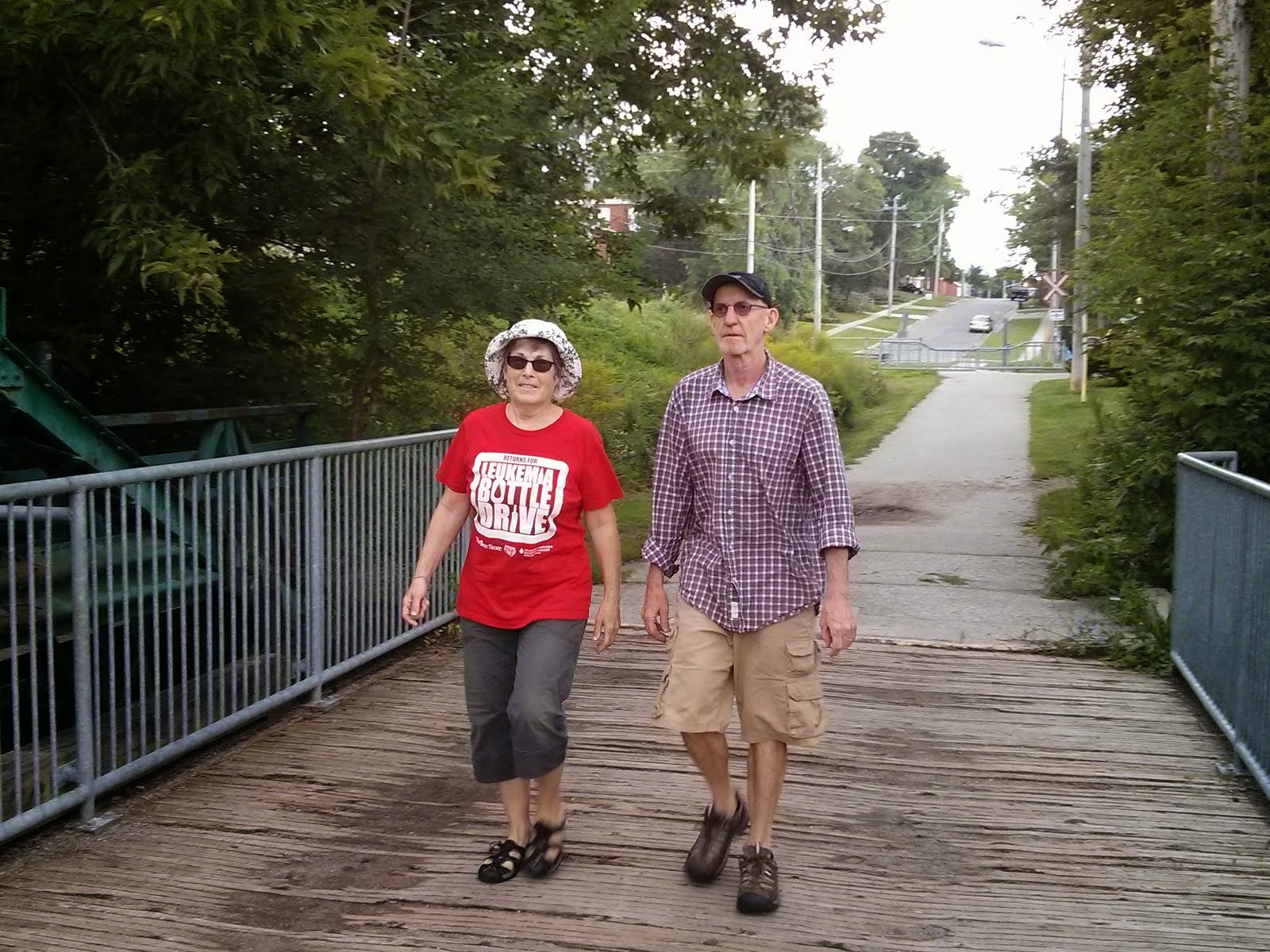
Kris and Mark, walking advocates


IMG_20140812_141118.jpg

Why is walking important to you?

Walking is a healthy activity.  It’s also autonomous. You get to determine the route that you want to go.  It also gives you opportunities to observe your environment.  It lets you happen upon things that are unexpected.

We love being out in the weather.   Rain and snow aren’t discouragements.

How has it changed your relationship with your community?

I think we are more aware of what’s in our immediate community. By walking, we enjoy a park across the way, natural areas like trails along the river. We enjoy walking in and around various neighbourhoods and in the downtown, observing the  architecture, people going about their business.  

You understand how an inner city works.  You get a sense of the history of the neighbourhood. You hear all the urban sounds.  I heard the bells ring at St George’s church and you hear the Go Trains coming and going and freight trains coming in the distance.

We like being in public spaces like Carden Street and City Hall. Plazas and public places are areas for people to walk, to interact and to engage in cultural activities.  

When walking downtown, you see people from  various walks of of life and backgrounds. We have become aware that we live in a diverse community.

When you’re walking around in the city, you notice that not everything is clean and organized.  There is more texture and grit to the city.

When you walk, you are aware of transitions, you see old industrial buildings in the Ward. There is also Willow Street area,  which is a starting point for new immigrants. Here, you see greater ethnic diversity.

Where do you go when you walk?

Where don’t we go?  We go to the market, shops downtown, cafes and restaurants, the pubs, the museum, the concert hall, the hockey rink, the library, the doctor and dentist, the bus depot, the railway station, friends and local dances at a neighbourhood church hall. We like to check out back alleys and laneways, discover new and old signage, and observe how nature can take hold in unexpected spaces.

IMG_20140812_141047.jpg

When do you use the car?

We use the car to go to the YMCA and to shop at a west-end grocery store.  When we use the car, we usually combine our errands in order to make fewer car trips. Sometimes our car remains unused for few days at time in our parking spot.

What is the hardest thing about walking for transportation?

The sidewalks and their uneven surfaces. The city has painted many of the sidewalk hazards orange, which is helpful.  Private owners who have allowed vegetation to grow out onto the sidewalk.  In the winter, the sidewalk snow clearance by the city can be slow and haphazard. In Guelph, there is no culture for residents for taking on responsibility to clear snow and ice on sidewalks in front of their houses. I fell twice this past winter.  People, especially seniors, are hesitant to walk outside in the winter.  

Timing of traffic light signals for pedestrians.  At the intersection of Woolwich, Norfolk and Norwich, there is often traffic making a left hand turn on Woolwich even though the pedestrian signal is indicating it’s OK to cross. You have to be mindful of this. A three to five second delay in the pedestrian signal would be helpful.
Drivers sometimes don’t stop when making a right hand turn on a red light when pedestrian is crossing because drivers think that they have the right of way.  You have to very alert as a pedestrian and err on the side of caution.

Has your enjoyment of walking influenced where you chose to live?

When one lives in the urban core, walking is a preferable option to driving. We chose to live in downtown where there are interesting and practical things close by.  

Where do you most like to walk?

We like to go to where there is life out on the street.  We like to get ice cream from the Sweet Shoppe downtown.  It is also pretty around Exhibition Park. We like walking through ol neighbourhoods and exploring trails along the rivers.

Where do you least like to walk?

I took the car to the Mazda dealership on Woodlawn Road and had to walk a distance down the goat path.  I went to the Royal City Nursery on Woodlawn and witnessed a woman pushing a stroller on the goat path. It is so unsafe and unpleasant.  I don’t like to walk next to high traffic roadways, where there are no sidewalks.

Any other comments?

In Raleigh North Carolina, there are wayfaring signs, such as “3 minutes to the art gallery” and “10 minutes to the train station.” I think it is a great idea.  Most signs in Guelph are signs for cars. There are very few for walkers.

More people walk than ride a bike.  Because the urban core is compact, it makes it appealing to walk. There are more people out on the street.  People on the street makes a safe, healthy, and vibrant community.  If you’re removed from interacting with your physical environment, you become estranged from it.  You have greater ownership and investment in your community if you walk.

When you drive a car, you take your livingroom with you and you don’t interact with other citizens except when you honk or you are on your cell phone.  That is another reason why we prefer the walking option.  For us, walking is frequently the journey, and not necessarily arriving at a destination.

Friday, 8 August 2014

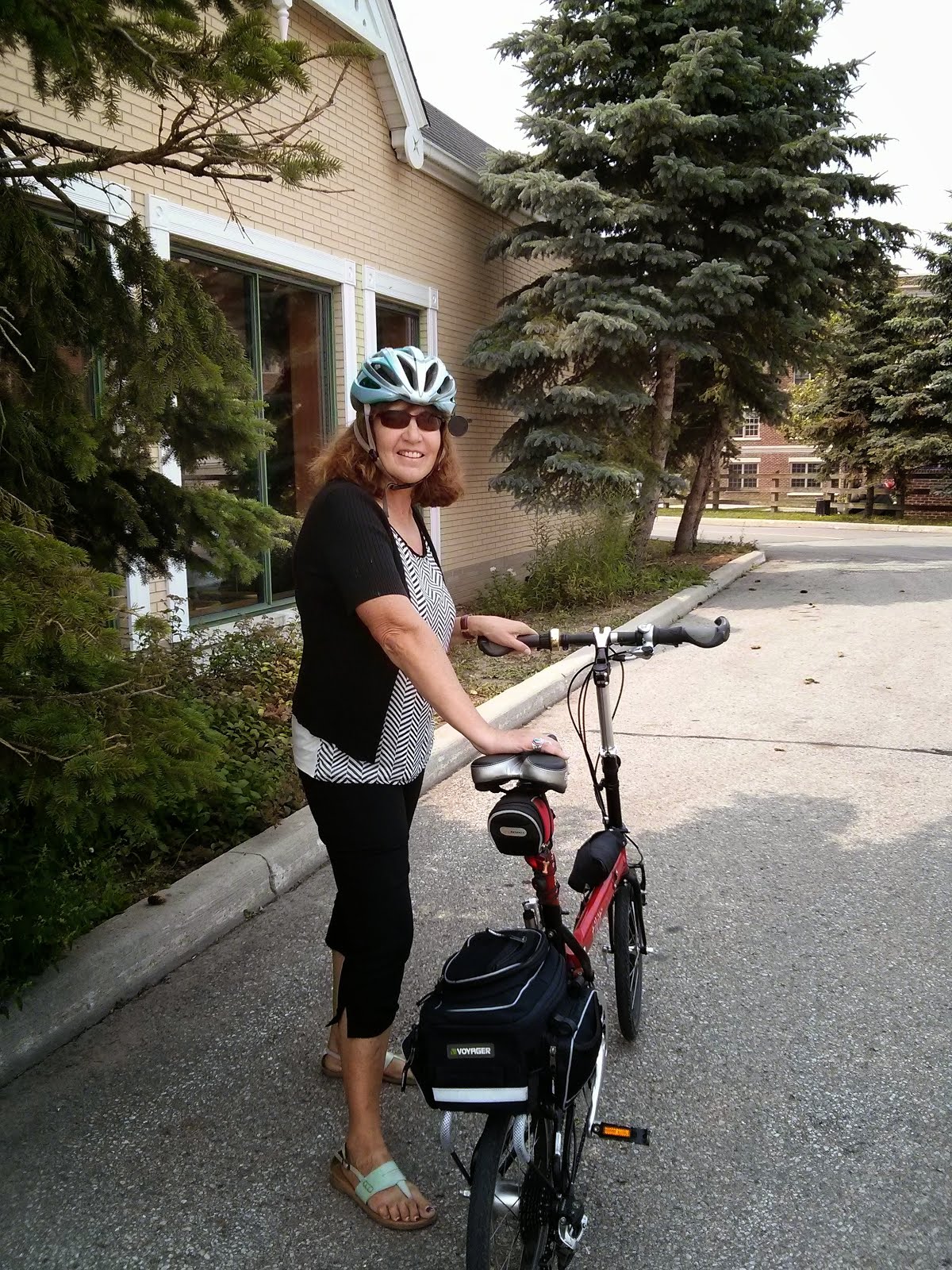
Profile of Maggie Laidlaw, City Councillor for Ward 3 and everyday cyclist in Guelph


Why is riding a bike important to you?


It is important to me because it benefits the environment and my health.


IMG_20140807_134847.jpg

How has it improved your life?

  • Financially it is much, much cheaper to own a bike rather than a car. You use your own energy rather than fossil fuel energy.
  • It keeps weight and blood pressure within normal range, which can prevent diabetes.
  • It’s also aesthetically pleasing.  Since they temporarily blocked off the McCrae bridge bicycle route, I now cycle through Royal City Park, which is beautiful.  
  • I get to say good morning to people on my bike.  I feel more a part of my community.  
  • Emotionally, it lifts my spirits.  It keeps me fully awake and ready to go when I start work.


What is the hardest thing about using the bike for transportation?


Canadian winters and bike lanes covered with snow! I still commute in the winter but I do it with difficulty when I have only a narrow strip of road on which to ride.


Were there fears you had in the beginning that have been disproved? Any that have proven valid?

I started biking as an adult.  My first trip was biking across Canada, which is how I met my cycling husband!
I have learned to always be wary of traffic.  I actually check for texters in my rear-view mirror.  I can tell they are texting when they stall at a traffic light even though it turns green.  If I am sure they are texting, I report them to the police.


What is your current bike set-up?

I have a commuter bike which is a regular hybrid bike.  I have a foldable travelling bike that fits into a suitcase and my off-road bike and my recumbent.  We have two tandems and a foldable tandem.


How would you respond to people who feel a car is just safer?

More people are killed in cars than on bikes, even when considering deaths and injuries by percentage. Look at all the car recalls and the damage they do.  Bikes are safer.


What needs to happen in Canada to make the culture, and eventually the roads, more bike friendly?
  • We need bike lanes within and between cities.
  • We need an update of the Highway Traffic Act.  We should be allowed “Idaho stops”- the Idaho stop is the common name for a law that allows cyclists to treat a stop sign as a yield sign.
  • We need contra-lanes on one-way streets.
  • We need a one-metre safe passing law.
  • We need to educate drivers about the rules of the road.
  • We need bike infrastructure, such as proper bike lanes that don’t stop 100 metres back from an intersection.
Give cyclists some of these perks for reducing congestion and keeping the environment clean, and we might get more people biking.


What is the best part of your commute?


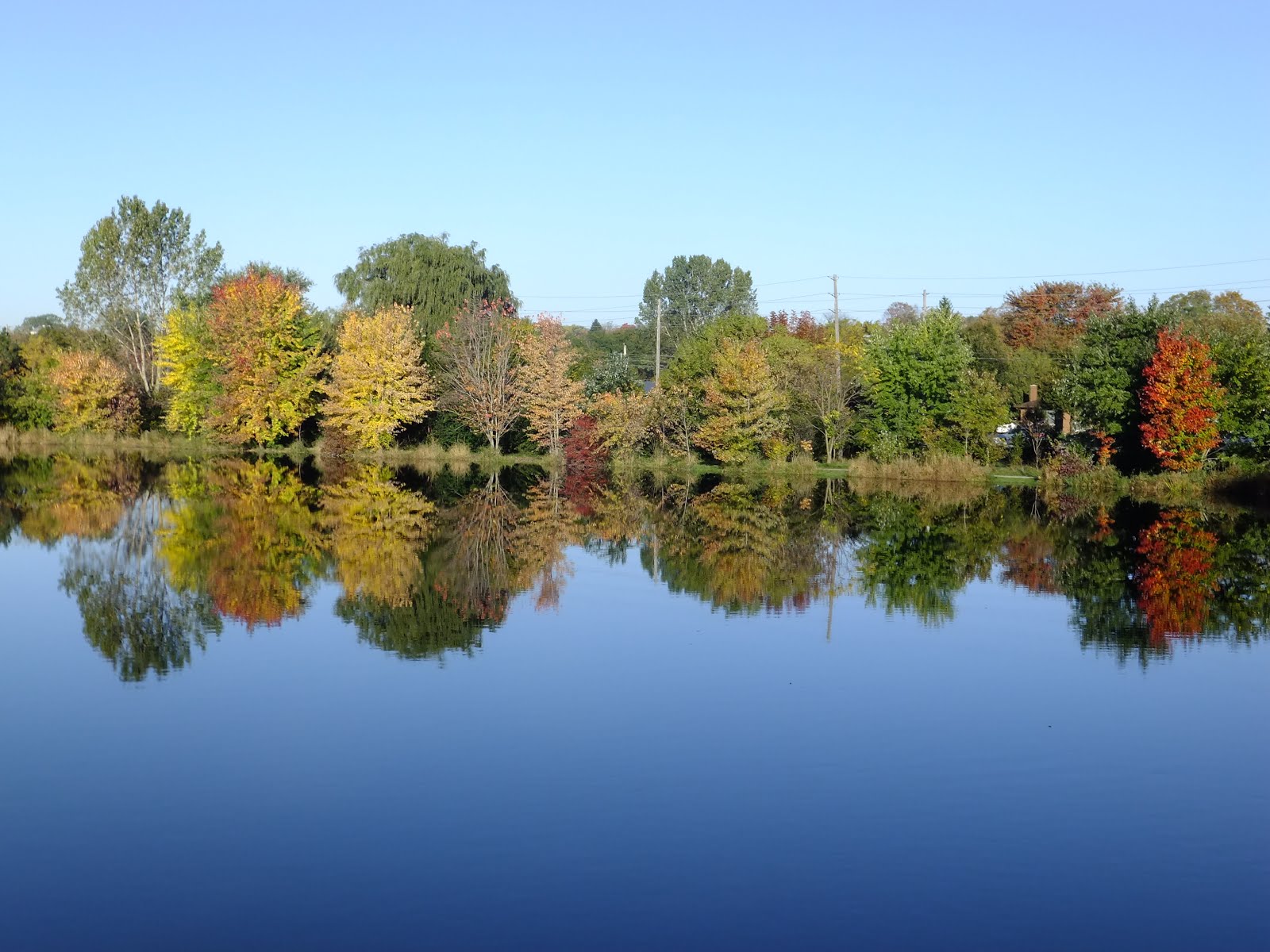
I like going through the neighbourhoods with beautiful gardens. Because I am cycling, I am able to  stop on the McCrae bridge and enjoy the beautiful sunrise. I once took a photograph at this time.  The water was crystal clear, reflecting the trees.


It’s hard to spontaneously take a picture like this when driving a car!


What is the worst part of your commute?

Winter time, when going up the Gordon Street hill and the snow is scraped off of the road on to the bike lanes.


What infrastructure change would make your commute better?

  • Clearing the bike lanes so that they can be used in the winter time.
  • More workplaces with good showers, and good bike shelters and lockups like at the university.


What bit of advice would you like to share with new bike commuters?
  1. Get a mirror. It will save your life.  Keep an eye on traffic coming from behind and in front.          
  2. Don’t go on main arterials in the beginning.  Start off by using quiet neighbourhood streets.
  3. Dress properly.
  4. No ear buds!
  5. Wear a helmet.
  6. Take the Can-Bike Course.